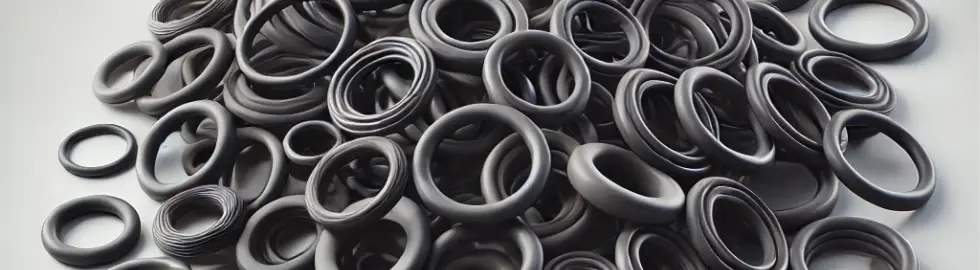
O-rings function as a means of sealing, essentially closing off a passageway to prevent the escape or loss of a fluid, either a liquid or a gas. An O-ring has a toric shape, and is typically manufactured from an elastomeric material. The seal is established by placing the O-ring into a cavity, known as a gland. The gland acts to compress the O-ring, and produces a zero-clearance condition, which effectively blocks the flow of the fluid. The sealing effect is produced through axial or radial compression of the O-ring.
In general, O-ring seals are considered to be particularly reliable due to the simplicity of the O-ring/gland design and overall material resilience. However, under a number of circumstances failure can occur. O-ring failure can range from minor leakage to catastrophic equipment breakdown. Regardless of the magnitude, an O-ring failure can be diagnosed through proper visual and analytical techniques.
This course will review:
O-ring Function
Failure Modes
Sealing System Design Factors
O-ring Materials – Selection and Specification
At the end you will:
Better understand how O-rings function.
Appreciate the potential failure modes for O-rings.
Gain insight into what material properties are important when selecting or specifying O-rings.
Jeffrey A. Jansen is the Engineering Manager and a Partner at The Madison Group, an independent plastics engineering and consulting firm. Jeff is a proven plastic professional with more than 30 years of experience solving problems and addressing opportunities related to polymeric materials. He specializes in failure analysis, material identification and selection, as well as compatibility, aging, and lifetime prediction studies for thermoplastic materials. Jeff has performed over 5,000 investigations, both for industrial clients and as a part of litigation. He is a regular presenter on the SPE webinar series, covering a wide range of topics related to plastics failure, material performance, testing, and polymer technology. Jeff is a graduate of Carroll College and the Milwaukee School of Engineering.
Maintenance Professionals: Ensure system reliability by understanding how O-ring performance impacts maintenance schedules and preventing leakage-related breakdowns.
Designers of Hydraulic/Pneumatic Systems: Enhance your designs by selecting the right O-ring materials and configurations to achieve optimal sealing performance.
Machinery Designers: Gain insights into integrating O-rings into your machinery for improved durability and reduced system failures.
Rubber Professionals: Contribute to O-ring innovation by deepening your knowledge of material properties and failure modes.
Consultants Specializing in Failure Analysis: Strengthen your expertise in diagnosing O-ring failures to deliver effective solutions and improve system performance.
This on demand workshop is ideal for professionals looking to optimize sealing systems, reduce maintenance costs, and improve overall equipment performance.
Why Should You Purchase On Demand?
Are you working with rubber O-rings and need to ensure they provide optimal sealing performance? Whether you're in design, maintenance, or quality assurance, understanding the function and potential failure modes of O-rings is crucial for maintaining the integrity of your sealing systems.
Is your equipment or tooling suffering maintenance breakdowns due to constant leakage?
Identifying and addressing O-ring failures is key to preventing costly downtime and ensuring your systems operate reliably.
Are you looking to learn about the factors that influence O-ring failure and how to prevent costly breakdowns?
Understanding the conditions that lead to O-ring failures, from minor leaks to catastrophic failures, is essential for improving system reliability and reducing maintenance costs.
Are you involved in selecting or specifying O-ring materials and want to know which properties are crucial for optimal performance?
Choosing the right material for your O-rings is vital to ensuring proper sealing under various operating conditions, such as temperature, pressure, and chemical exposure.
If these concerns sound familiar, the Rubber O-rings SPE course is designed for you!
This course will provide in-depth insights into the function of O-rings, the factors contributing to their failure, and the key material properties to consider when selecting or specifying O-rings. Gain practical knowledge to optimize your sealing systems and prevent costly failures.
Color and Appearance Division Call for Papers
Any paper related to the color and/or appearance of plastic will be considered. Appropriate topics might apply to one of these categories:
Color Measurement
Testing and Quality Control
Color Matching Techniques
Processing and Equipment
Materials (Colorants, Additives, Polymers)
Property Retention/Durability
Instrumentation and Test Methods
Regulatory Issues
Color Trends
Decorative or Special Effects
Other Color/Appearance Related Topic
SPE Additive Manufacturing Special Interest Group Call for Papers
SPE Additive Manufacturing Special Interest Group invites you to submit your original work in the area of additive manufacturing/3D printing (3Dp) of plastics/composites.
SPE Composites Division Call for Papers
Any paper related to composites will be considered. Appropriate topics might apply to one of these categories:
SPE Recycling Division is currently soliciting high-quality papers that expound on the very latest technologies. Be part of this exciting session by sharing your company or institution's recent advances and help us identify new technologies that will proliferate sustainability. Paper topics include, but are not limited to:
Chemical and mechanical recycling
Circularity of materials
Tackling challenges in plastic waste
Sustainability in materials, design and manufacturing
Novel methods for deconstructing and upcycling existing plastic waste
Innovative applications for material repurpose, reuse, recycle and upcycle
SPE Engineering Properties & Structure Division Division Call for Papers
SPE Engineering Properties & Structure Division is focused on new topics and fundamental understanding in the interplay of plastics engineering and polymer science. This year, we are addressing the theme of:
“Tailoring Polymers for Targeted Performance”
Paper topics include, but are not limited to:
Antimicrobial and antiviral polymer systems
Multi-layer polymer structures and adhesion
Reactive processing of polymers and coatings
Coating and confinement effects on physical properties
Inorganic composites and nanocomposites
Modification of polymers for improved sustainability
We welcome papers on novel research in polymer science and engineering, polymer structure-property relationships, and mechanistic understanding of practical or applied problems.
Bioplastics and Renewable Technologies Division Call for Papers
Any paper related to bioplastics and/or renewable technologies will be considered. Appropriate topics
might apply to one of these categories:
Innovations in Bio-based and/or biodegradable polymers and plastics
Compostable or biodegradable Packaging and food contact innovations
Additives for bio-based and biodegradable plastics
Advancements in recycling of bioplastics
New durable and biodegradable applications introduced in 2020
Multi-use bio-based products
Biodegradability of polymers and plastics outside of managed waste streams
Technical Developments in Bioplastics or Bio-composites
Carbon footprint and Life Cycle Assessment
New Legislation and Regulations
Breakthrough Process Technologies
Innovative Applications and/or end uses
Home and Industrial Compost-ability
If you have any questions, please contact our Technical Program Chair for ANTEC® 2021
Frank J. Popola.
SPE Plastic Pipe and Fittings SIG Call for Papers
Plastics play a major role in the piping industry. Applications include gas and water distribution, gas gathering/oil field production, residential plumbing, rehabilitation, irrigation, drain waste and vent, fire suppression system and many others. The choice of polymers instead of traditional pipe materials is due to the advancement in pipe materials, additive technology, processing systems, material characterization and test methods. Plastic pipe and fittings SIG is soliciting papers for the ANTEC® 2021, March 22 - March 26 at the Sheraton Denver in Downtown Denver, Colorado. Topics to be covered will include:
Development of new pipe & fittings materials
Innovation in processes including joining and installation
Advances in test methods
New applications of existing technology
Success stories and challenges in plastic pipe applications
Topics of current interest to the pipe and fittings industry
Papers dealing with these or allied topics will be considered for Plastic Pipe and Fittings sessions. The sessions will provide a unique meeting point to discuss current trends and opportunities for any professional working on pipe and fittings area comprised of thermoplastic and/or thermoset materials. This year, the SIG is also soliciting Technical Marketing Presentations which will be organized into sessions focused on specific topical areas. These sessions are intended to be a forum where new products, processes, and services can be effectively shared with ANTEC® attendees in a timely manner. While not intended as a sales presentation, no written paper is will be required. Rather a presentation is required that will be subject to review and approval by the ANTEC Advisory Committee.
We are also thrilled to announce that this year’s best presentation award will be sponsored by the SIG Organizing Committee. The award recognizes technology advancements for thermoplastic piping systems which connect communities through infrastructures in gas and water distribution, gas gathering/oil field production, residential plumbing, rehabilitation, irrigation, drain waste and vent, fire suppression systems and many others.
Inquiries—Please contact Nathanial Evans
Technical Program Co-Chair, Plastic Pipe and Fittings SIG n.evans@bryanhaugerconsulting.com; Tel: +1 918.607.0619
SPE Mold Technologies Division Call for Papers
SPE Mold Technologies Division is glad to announce that submissions for the 2021 ANTEC conference are now being accepted. Mold designers, engineers, makers, researchers, and educators, are all invited to present their research and development updates at our session! This would be the opportunity to connect with experts in your field and share great discussions around mold technologies and innovations. Submissions for the following topics are suggested:
Innovation in mold design, engineering, and making technologies;
Mold maintenance;
Mold surface engineering and treatments;
Mold design education and workforce development;
Impact of COVID-19 on the plastic mold industry;
And more…
The conference will be held in a hybrid format allowing everyone to participate, present, and engage remotely. Last year, the remote ANTEC® 2020 conference was a success for the Mold Technology Division, with more than 150 participants to our session and great Q&A discussion.
For additional information please contact our Technical Programming Chair, Davide Masato, Davide_Masato@uml.edu
The Flexible Packaging Division is looking for technically oriented papers and presentations on topics related to flexible packaging.
Examples include:
improvements in barrier;
new tie layer systems;
flexible packaging equipment;
breakthroughs in flexible package recycling;
sustainable packaging solutions;
smart & active packaging;
e-commerce solutions;
film extrusion and converting technologies;
flexible package testing;
And, novel pack functionality
SPE Polymer Analysis Division Call for Papers
SPE Polymer Analysis Division (PAD) invites presentations for ANTEC 2021 on the following topics, as well as others that can be considered Polymer Analysis.
Processing-structure-properties relationships
Analysis of biobased and biodegradable polymers/composites
Hyphenated characterization techniques
Emerging methods of polymer spectroscopy
Characterization and analysis of polymers/blends/composites/ nano-materials/microfluidics/hydrogels/fibers/polymer additives
Biocompatibility of plastics
Advances in polymer analysis techniques
Instrumental innovations
SPE Applied Rheology Division Call for Papers
Applied Rheology Division of SPE aims to bring together academic and industrial scientists and researchers to share their research results and most recent innovations on all aspects of polymer rheology. The topics can be, but not limited to the following area:
Theoretical and experimental work in all areas of rheology
Relationships of processing-structure-rheology
Rheology of polymer solutions, polymer melt, composites and colloid systems
Application of rheology in innovative processing, product development and failure analysis
In addition to the industrial researchers and academic professionals, the graduate students are strongly encouraged to participate this virtual conference. The “Best Student Paper” in the Applied Rheology Division will be selected and awarded.
SPE Decoration and Assembly Division Call for Papers
You are invited to submit a paper for publication and presentation.
The Decoration and Assembly Division is looking for papers on the following topics:
Post Covid-19 treatments and coatings for plastic surfaces
Digital (ink jet) plastic decoration
Adhesives for difficult to bond plastic surfaces
Sustainable choices for plastic decoration
Advances in laser technologies for decorated plastic
Surface preparation for plastic decoration
Decoration processes for additive manufactured parts
Smart materials and coating technologies to create smart surfaces
SPE Building and Infrastructure Division Call for Papers
ANTEC® 2021 Building and Infrastructure section call for all the papers that are related to Building and Infrastructure applications, especially new or improved materials (composite materials, recycle materials, energy saving materials, sustainable materials, self-healing/repairing materials, smart materials, polymers and additives), new technologies, new applications and new regulations under the following application suggestion list, but not limited to the list.
Roofing, siding, fence, deck, trim boards, windows, doors, floors
Pipes, insulations, wire & cable, bath and kitchens
Paints & coatings, adhesives & sealants
This educational program is provided as a service of SPE. The views and opinions expressed on this or any SPE educational program are those of the Speaker(s) and/or the persons appearing with the Speaker(s) and do not necessarily reflect the views and opinions of the Society of Plastics Engineers, Inc. (SPE) or its officials, employees or designees. To comment or to present an opposing or supporting opinion, please contact us at info@4SPE.org.
Refund Policy
Full refund 30 days prior to the event start date. Please contact customerrelations@4spe.org for assistance with registration.
Copyright & Permission to Use
SPE may take photographs and audio/video recordings during the conference, pre-conference meetings and receptions that may include attendees within sessions, networking areas, exhibition areas, and other areas associated with the conference both inside and outside of the venue. By registering for this event, all attendees are providing permission for SPE to use this material at its discretion on SPE's websites, marketing materials, and publications. SPE retains ownership of copyright to all photographs and audio/video recording obtained at this event and attendees may request copies of any material in which they are included.
Anti-Trust Statement
No discussion among members, volunteers, or staff, which attempts to arrive at any agreement regarding prices, terms or conditions of sale, distribution, volume, territories, or customers;
No activity or communication which might be construed as an attempt to prevent any person or business entity from gaining access to any market or customer for goods or services or any business entity from obtaining services or a supply of goods;
No activity or communication which might be construed as an agreement to refrain from purchasing or using any materials, equipment, services or supplies of or from any supplier; or
No other activity which violates anti-trust or applicable laws aimed at preventing unfair competition.